The Math Girl
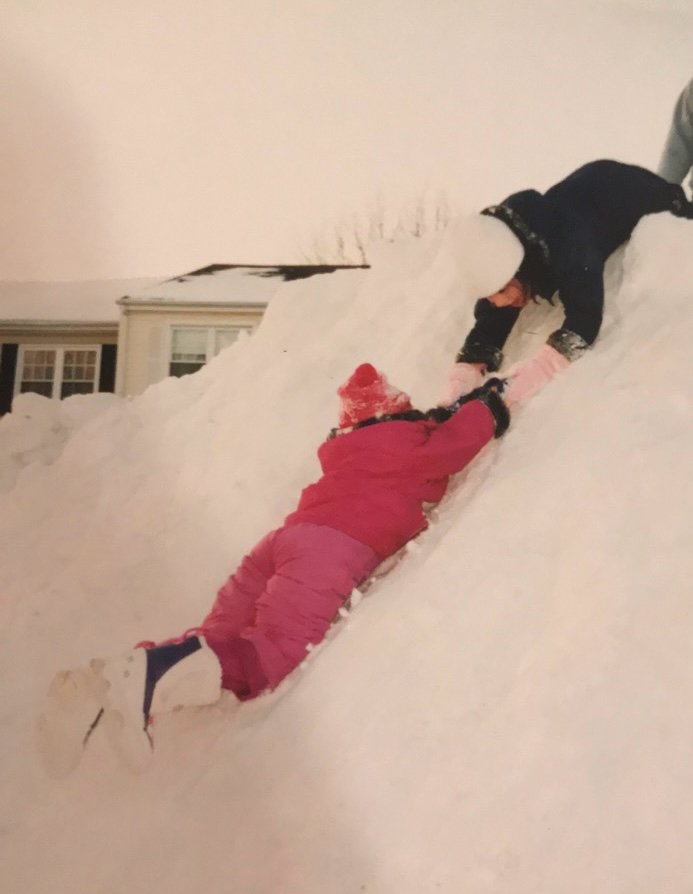
This was taken around the age I learned to stop raising my hand, already reaching to hold on to something the world was quietly letting slip away.
I have been finding myself coming face to face with grief a lot lately, and not just in the form we tend to automatically think when we hear the word “grief.”
Grief is often spoken as if it only belongs to death. As if it begins at someone’s last breath, amplifies at a funeral, and then softens with time. In reality, in ordinary human life, grief is a multidimensional experience that extends well beyond bereavement.
While death-related loss remains one visible form, humans also encounter collective and sociopolitical grief of uncertainty, anticipatory grief that arrives before anything has ended, ambiguous loss that never receives a clear name or ritual, developmental grief as it relates to disrupted expectations or unrealized identities, relational loss of humans that are still alive and breathing, and transitional grief that is accompanied by healing, growth, and necessary change.
Even positive movement can evoke mourning for what is being left behind. In this way, grief functions not only as a response to endings, but as an adaptive emotional process signaling attachment, meaning-making, and transformation across the human lifespan.
Lately, the form of grief I notice most is the grief that is connected to the un-lived parts of ourselves.
I minored in philosophy, where I have studied numerous philosophical and psychological concepts. One idea that has stayed with me long after leaving those lecture halls is the Pygmalion Effect: a psychological principle, often discussed in philosophical contexts, describing how expectations, attention, and belief can meaningfully shape who a person becomes.
My professor powerfully illustrated this concept through a story. I have often referred to this story as “The Math Girl.”
And the story goes:
There was once a girl who was brilliant at math.
Not simply good at it in the way a report card measures, but instinctively, quietly, brilliant. Numbers made sense to her before anyone explained them. Patterns appeared with clarity where other students saw confusion. Solving problems felt less like work and more like following something already unfolding in her mind.
Her capacity for math was rare enough that it carried the quiet ability to change the world. If you were paying attention to her in elementary school, you would have known you were witnessing the beginning of something magnificent to come.
She came home after school every day and did her math homework first, not out of discipline, but out of genuine interest and passion. In class, her hand rose eagerly. She waited to be called on with the simple confidence of someone who believed the world would meet her where she was reaching.
Nothing obvious happened to interrupt this. No teacher told her she was wrong. No failure forced her to stop. There was no single moment that could be named as a turning point.
But no one clearly saw her potential, either.
So, by middle school, the shift was subtle enough to pass unnoticed.
She still completed her math homework carefully, though she now did it after English. She still raised her hand in Math class, though she was not as eager to answer, and sometimes let others answer instead. Praise in the classroom gathered around other students who possessed different strengths.
Beneath the ordinary rhythms of mundane school life, she absorbed a quieter lesson, one the world had taught girls for a very, very long time: brilliance in mathematics usually did not belong to them.
No one needed to say this aloud. It lived in expectations, attention, and encouragement. She learned it the way children learn most societal rules: by watching who was celebrated and who slowly disappeared.
So, unconsciously, she adjusted, almost imperceptibly, in the careful way most young people adapt in order to achieve the thing that matters greatly to them: belonging.
By the time high school rolled around, the change felt like no other. In fact, it felt normal.
Her math homework was completed last after every other subject. She stopped raising her hand in class altogether. The subject that once felt alive simply became another state requirement to complete in order to graduate.
She did well, nothing on record suggested loss. Her life continued forward in a way that many would measure as meaningful and successful on the outside.
She graduated. She went to college. And she never did anything with math again.
The world never changed because of her brilliance, not because it wasn’t there, and not because she consciously chose against it, but because the conditions that might have allowed it to grow never fully formed.
And the most difficult truth of all: she did not know anything had been lost.
Because it is impossible to grieve a life you were never given the chance to imagine.
I often wonder how many of us carry some version of this story. How many parts of ourselves were once alive with curiosity or direction, quietly shaped towards something meaningful, and then somewhere along the way, learned to shrink rather than grow?
How many of us, in ways both subtle and ordinary, were taught to put our hands down rather than raise them proudly?
My professor often suggested that we all have a “math girl” somewhere inside of us. There are “math girl” parts I recognize quite clearly, while there are others I suspect, I may never get the opportunity to fully know. For a long time, this idea clouded me with resentment and grief. I would wonder: what might my life have been if…
Humans tend to grow towards what is noticed, encouraged, and made room for. They tend to move away from what is unseen, unsupported, or quietly dismissed. Due to my awareness of the Pygmalion Effect, I have consciously created space to celebrate, notice, and encourage my own parts in everything I choose to do.
No matter how old you are, it is never too late to foster your overlooked and unseen parts. It is never too late to choose yourself while simultaneously grieving the moments those parts were not chosen.
From a parts-based lens, the “math girl” does not vanish. She becomes protected, quieted, by the very systems inside us that learned how to keep us safe and connected.
Healing is not the creation of a new Self. It is the gradual re-meeting of the selves that had to step back in order for us to belong. And while we may never live every life that once felt possible, we can begin to grant ourselves permission to grow in directions we were once taught to abandon in the current life that remains.
And perhaps, sometimes, healing is nothing more than learning to raise your hand again…
Even when no one else is watching.
written by: Darby Pistilli, LPC